TABU
Tyshan Wright
Curated by Laura Ritchie
Opening Reception: Thursday, March 5 at 6 pm
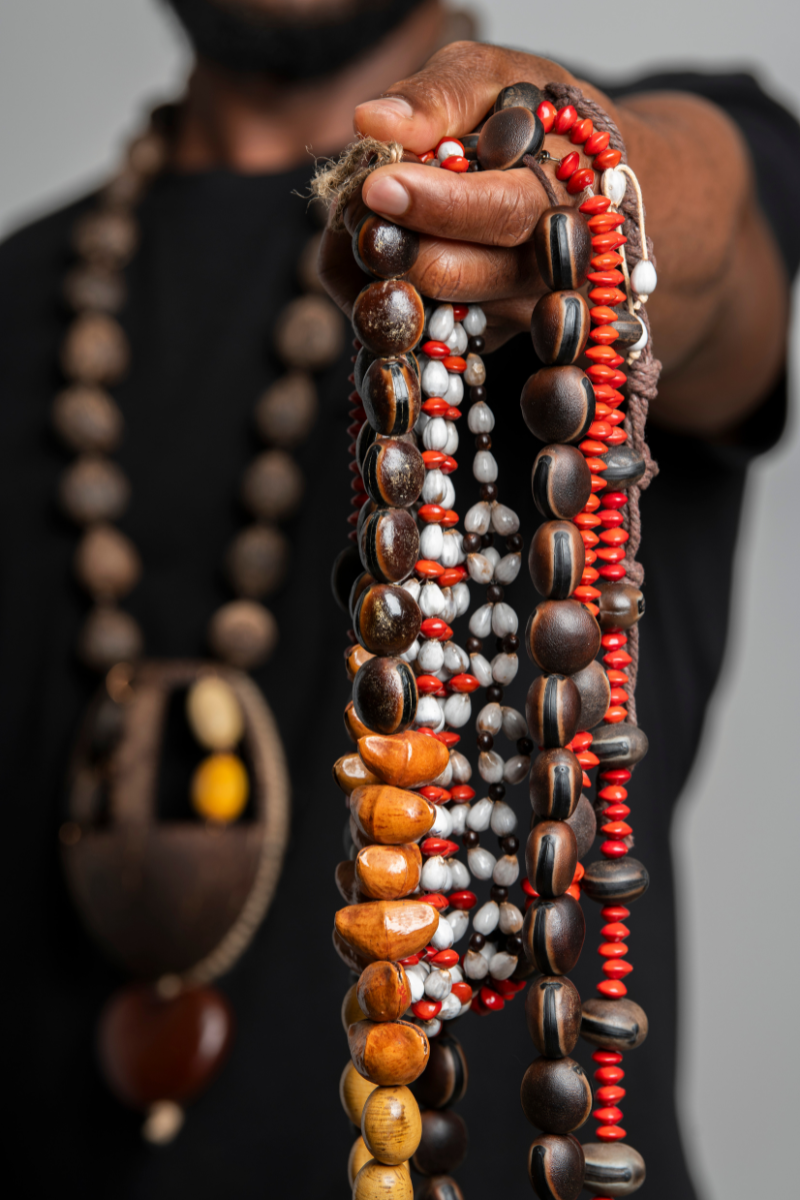
Image by Steve Farmer
Artist Biography
Tyshan Wright is an artist whose practice exists at the intersection of contemporary art and the cultural traditions of the Jamaican Maroons. Recognized as a ‘Keeper of the Heritage’ of the Jamaican Maroons, Wright’s work is rooted in self-taught cultural knowledge, independent research, and sustained studio practice. Working from Kjipuktuk (also known as Halifax, Nova Scotia), the unceded and ancestral homeland of the Mi’kmaq, Wright has been investigating the legacy of Maroons exiled from Jamaica to colonial Halifax in 1796. His work is included in the collections of the Nova Scotia Art Bank, the National Gallery of Canada, and other public and private collections. In 2022 Wright was the Atlantic region nominee shortlisted for the Sobey Art Award, and a recipient of an Emerging Artist Award from Arts Nova Scotia. He holds an MFA from Emily Carr University of Art + Design, where he was a recipient of a Canada Graduate Research Scholarship from the Social Sciences and Humanities Research Council of Canada (SSHRC). His work has been featured in exhibitions at various galleries including the Art Gallery of Nova Scotia, the Art Gallery of Ontario, the National Gallery of Canada, and the Confederation Centre of the Arts.
Exhibition Statement
TABU reflects a return and a response—connecting my present practice to my beginnings working to preserve Maroon culture and craft in Jamaica. In Accompong Town, St. Elizabeth Parish, I began as an artisan jeweller, creating Jamaican Maroon ornaments from seeds, nuts, and locally sourced materials, and sharing this work within and beyond the community. These early efforts were rooted in sustaining Maroon cultural heritage through making. This formative practice taught me that material carries history, memory, and responsibility. It shaped how I understand craft as a form of resistance—how making can sustain culture, and how adornment can function as remembrance. I continue to work from this lineage today, using reclaimed Indigenous Maroon beads and historical materials to create new forms and narratives. My process remains slow, intuitive, and meditative, creating space to reflect on memory, diaspora, resilience, healing, and continuity. TABU positions early acts of preservation within a larger continuum, where each object becomes both a vessel of history and a gesture toward future possibility.
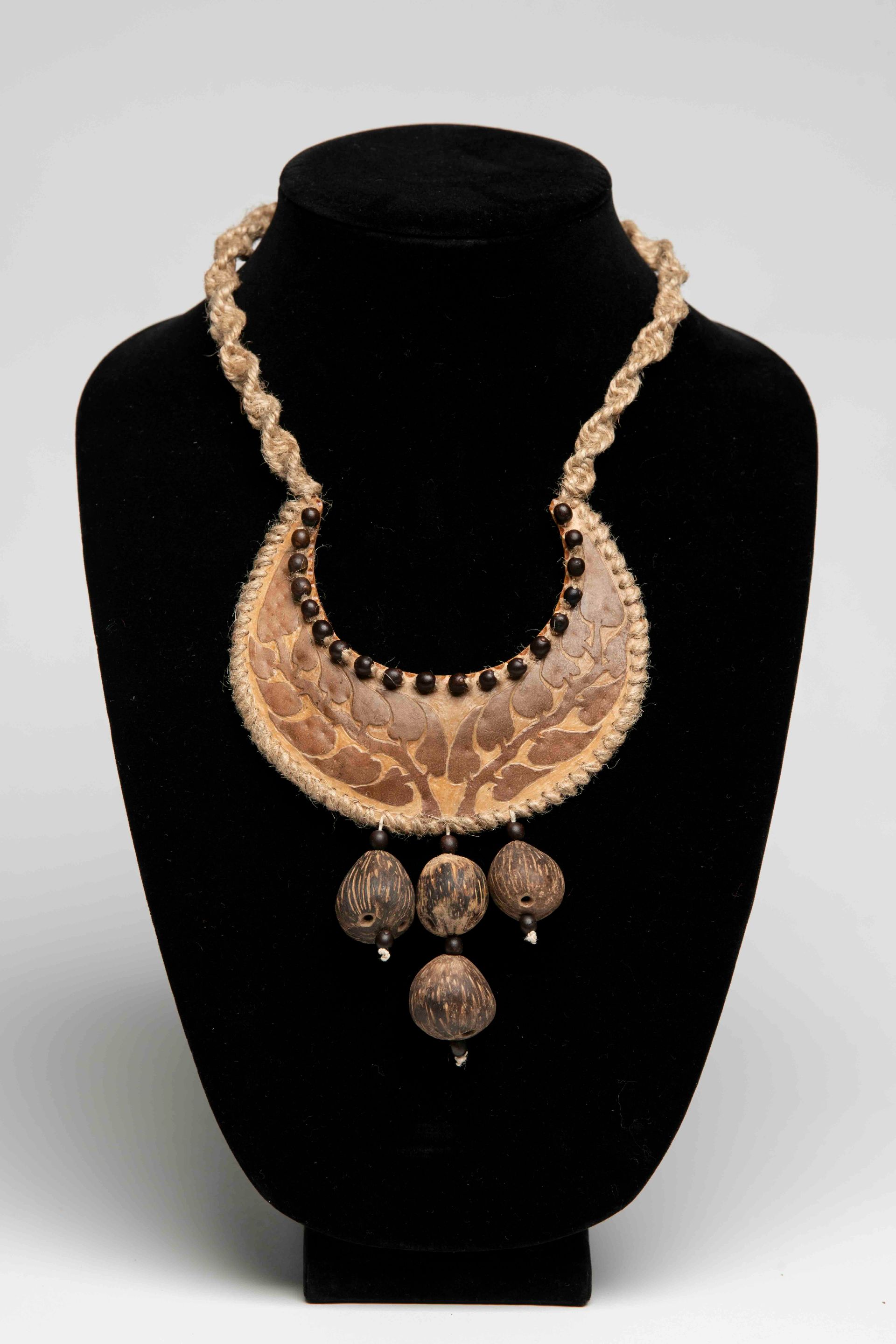
Image by Steve Farmer
Workshop: Making Together
Saturday April 18, 1–2:30 pm
Mary E. Black Gallery
Families are invited to drop in and spend time making together using simple wooden beads and natural materials. Children and their caregivers are welcome to join at any point during the session and stay as long as they wish.
Connected to the themes of TABU, this interdisciplinary activity introduces making as a slow and attentive process. Participants are encouraged to work at their own pace, exploring repetition, simple patterns, and the experience of working with their hands. Rather than focusing on technique or finished products, the workshop creates space for shared attention and care. Families are invited to create side by side and to consider how making together can hold memory and connection.
Participants are also encouraged to spend time with the exhibition TABU, where the workshop’s themes of material, memory, and continuity are explored through the artist’s work.
All materials will be provided. No prior experience is required. Drop in anytime during program hours.
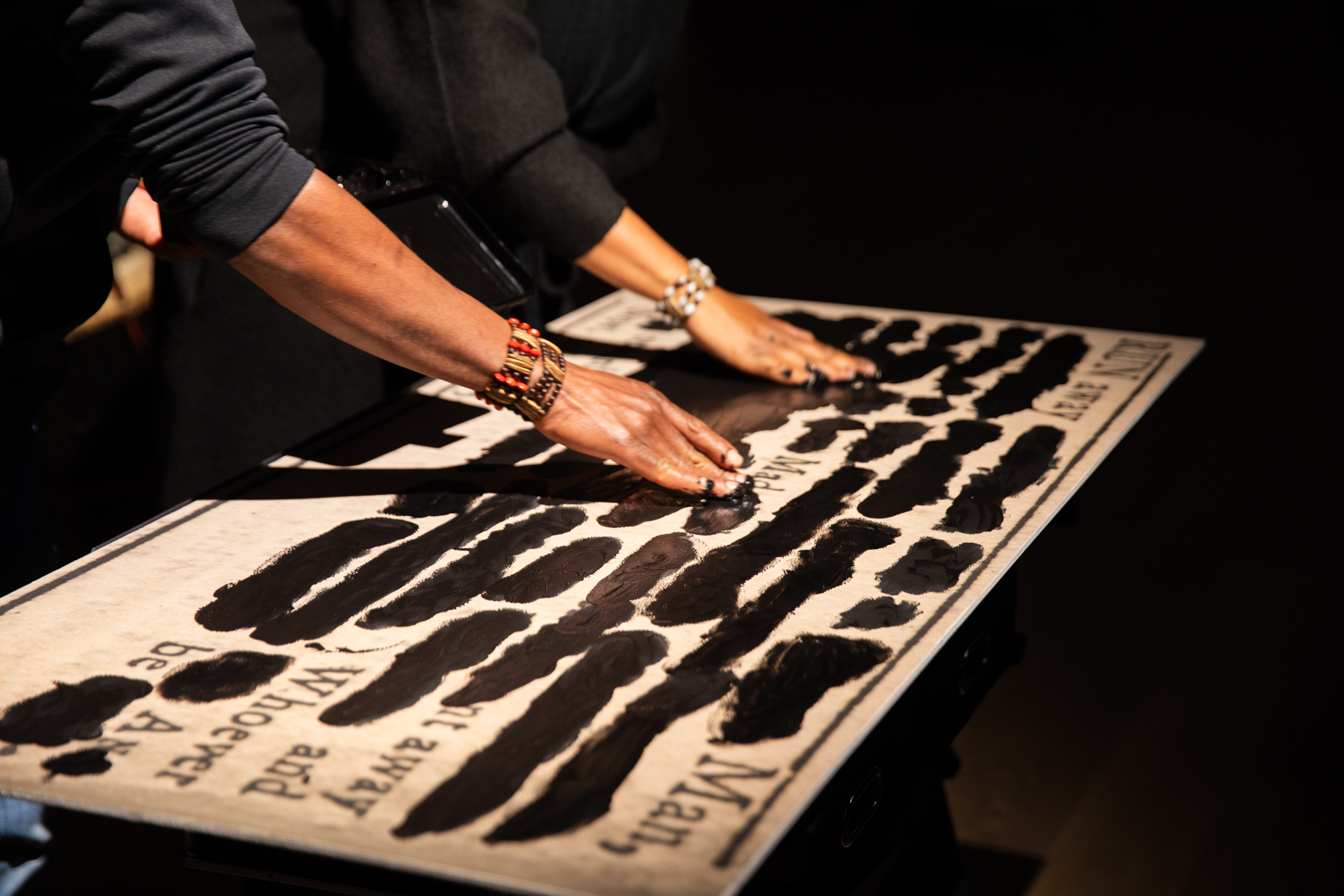
Image by Adams Photography
Erasure Art Collective: What Remains
Thursday March 26, 7–8 pm
Paul O'Regan Hall, Halifax Central Library
What Remains is a live, durational act of material erasure.
Working with materials left over from the making of TABU, an exhibition by Tyshan Wright—wood shavings, broken beads, unraveled fibers—the collective undertakes a slow process of dismantling and transformation.
These remnants are brought into contact with archival slave advertisements from Nova Scotia, Jamaica, and the wider Atlantic world. Through grinding, unraveling, and covering, the language of these texts is interrupted. Words are obscured, buried, and rendered illegible. What once attempted to name, price, and contain Black life is materially refused.
An overhead camera projects the collective’s hands in real time onto a large screen. This projection is not recorded. It exists only for the duration of the gathering.
Audience members are invited to sit and witness. You may enter or leave quietly at any point.
This is not a performance and not a reading.
It is an act of care through dismantling—
a collective holding of what remains.
Artist Talk: Presence and Memory in TABU
Thursday March 12, 12–1pm
Mary E. Black Gallery
Join Tyshan Wright for a guided experience of his exhibition TABU. Participants are invited to move through the gallery at a measured pace, observing, listening, and reflecting alongside the artist.
Drawing on histories of Jamaican Maroon exile and preservation, Wright will guide attention to the memories, lineage, and continuity embedded in the objects on view. Visitors are encouraged to notice relationships between material, narrative, and ancestry, and to consider how acts of making and care carry memory across time.
This session is a held space for contemplation and presence, where observations and reflections emerge naturally.
Acknowledgements
This exhibition is generously supported by 
Published ©2026 by the Centre for Craft Nova Scotia All rights reserved. No part of this publiscation may be reproduced or transmitted in any form or by any means electronic or mechanical, including photocopying, recording, or any information storage and retrieval system, without permission in writing from the publisher. Photography courtesy of the artist unless otherwise stated.