Artist Statement
Martina Lantin’s artistic practice engages the global archive of ceramic artifacts to reflect the mutation and adaptation of motifs and technologies. Throughout the post classical and early modern eras making methods and material knowledge moved around the globe through migration, war, and conquest. Her recent work is an examination of the pattern relationships found between pots across the full spectrum of ceramic history. Of particular focus is the influence on Chinese porcelain exports on the works produced in the Middle East and Europe. Through adaptation and innovation, the patterns found on the iconic blue and white porcelains have influenced makers of Persian frit wares, Renaissance maiolica, and early European porcelain.
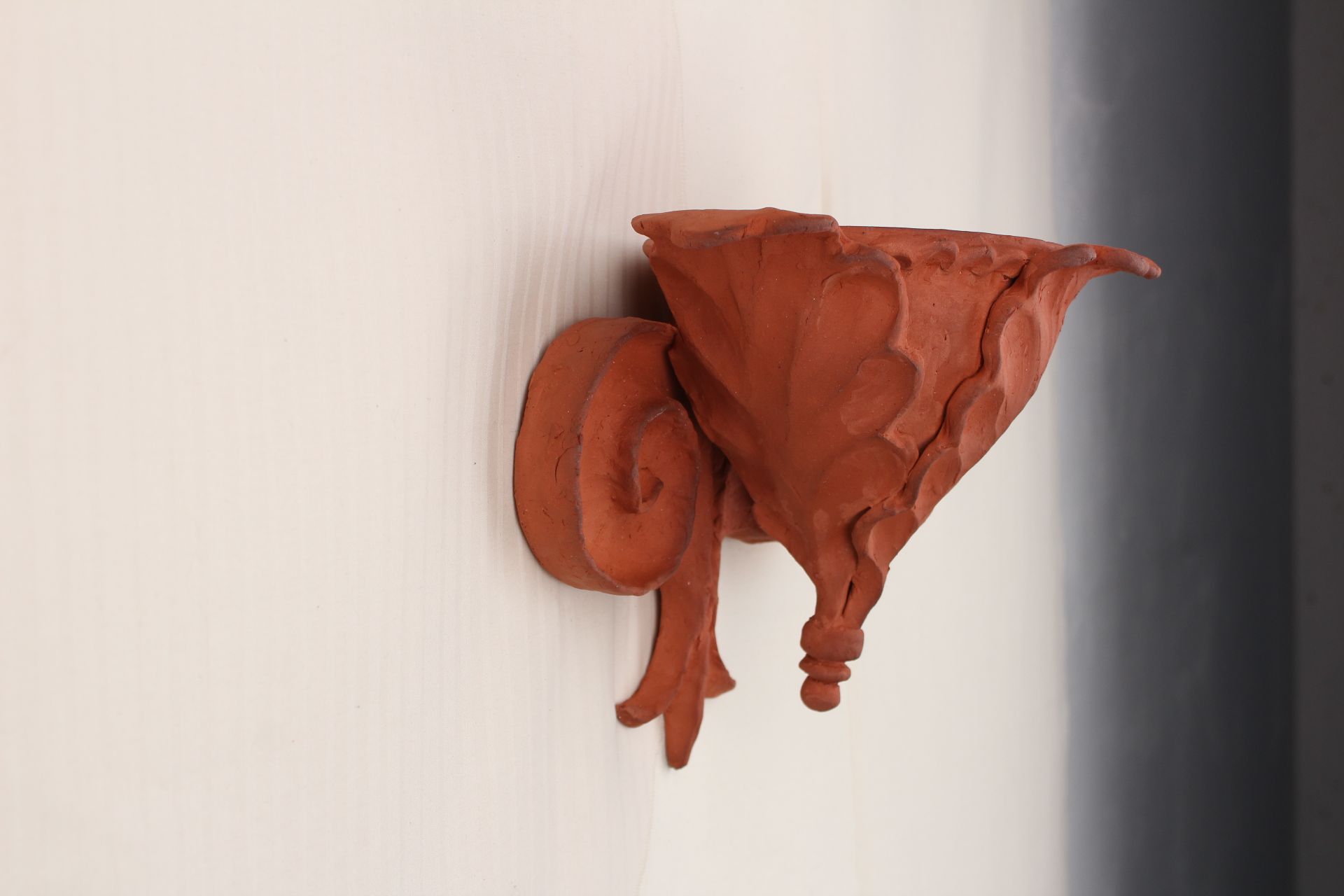
Layered lattices reformulate these historical motifs as a continuation of the mutation of ceramic vessels and surface design throughout history. Instead of brushstrokes, clay and glaze render the patterns. The stacks exhibited here compress these motifs – familiar as two-dimensional surface decoration – into forms that hold space as three dimensional objects. ‘Speculation’; an extensive plate and paper installation references the speculative grid cast by colonists across the unseen western territories in support of their perceived ‘divine right’ to have dominion over North America. The architectural intervention made of ceramics and textile components is inspired by the Porcelain Rooms of 18th century Europe. The visible piecing suggests architectural geometries as background for ceramic shelves that continue to hold space for their absent porcelain companions. Garden Urns on platforms along the windows highlight the soft malleability of clay through wheel thrown and hand-built elements. Though singular objects, they link to themes of migration and colonization as referents to the taming of wildness found in the formal gardens of the colonies and colonizers. This exhibition, through an exploration of architectural references and ceramic form and surface, is a robust engagement with material history. Earthenware, rather than porcelain; and textiles, rather than wood or plaster, privilege the every-day and thereby ground the works in the comfort of a domestic sphere.
Textiles composition constructed by Lael Chmelyk